 EN
EN

A Dual AC Ad EV Charger is best suited for locations where vehicles park for longer periods, such as residential communities, office parks, hotels, shopping malls, and destination parking. It offers lower infrastructure cost, easier installation, and strong advertising exposure through long dwell time.
A Dual DC Ad EV Charger is designed for fast-charging scenarios where drivers expect quick turnaround, such as highway service areas, fuel stations, commercial charging hubs, fleet depots, and high-traffic retail sites. It requires higher investment and stronger grid capacity but delivers faster charging speed, higher charging revenue potential, and premium user experience.
The key difference is this: Dual AC Ad EV Charger focuses on low-cost, long-stay charging with advertising value, while Dual DC Ad EV Charger focuses on high-speed charging, higher utilization, and faster revenue generation.
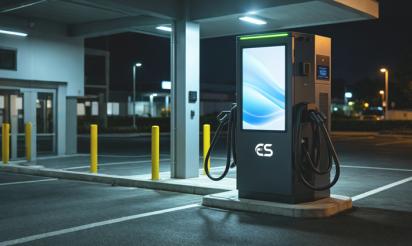
A Dual AC Ad EV Charger is an AC charging station equipped with two charging outputs, usually combined with a digital advertising display. It can charge two electric vehicles at the same time, commonly using Type 2, GB/T, or other regional AC connectors.
In most applications, AC chargers deliver power through the vehicle's onboard charger. This means the actual charging speed depends not only on the charger's rated output but also on the vehicle's onboard AC charging capability.
Typical power ranges include:
| Type | Common Power Rating | Charging Speed |
|---|---|---|
| Single-phase AC | 7kW | Slow to medium |
| Three-phase AC | 11kW / 22kW | Medium |
| Dual AC output | 2 × 7kW, 2 × 11kW, 2 × 22kW | Suitable for long parking |
For operators, the advertising screen can be used for brand promotion, commercial ads, parking guidance, charger instructions, membership campaigns, and local business promotions.
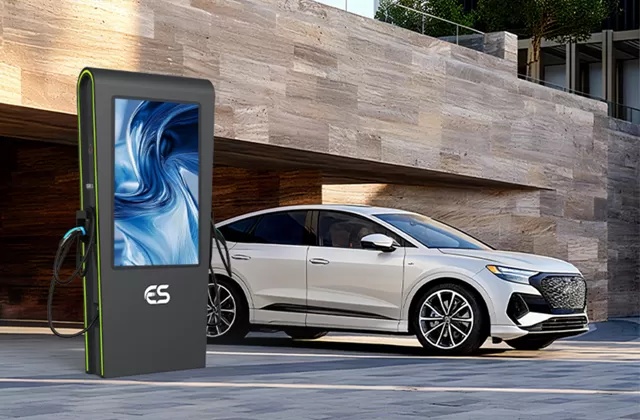
A Dual DC Ad EV Charger is a fast-charging station with two DC charging outputs and an integrated advertising display. Unlike AC charging, DC charging bypasses the vehicle's onboard charger and delivers direct current to the battery through CCS, CHAdeMO, GB/T, or other DC connectors.
Typical power ranges include:
| Type | Common Power Rating | Charging Speed |
|---|---|---|
| Low-power DC | 30kW / 40kW | Entry-level fast charging |
| Medium DC | 60kW / 80kW / 120kW | Commercial public charging |
| High-power DC | 160kW / 180kW / 240kW+ | Fast charging hubs |
A Dual DC Ad EV Charger is often equipped with dynamic power allocation. For example, a 120kW dual-output charger may distribute power as 60kW + 60kW when two vehicles are charging, or provide up to 120kW to one vehicle if only one connector is in use, depending on the design.
| Comparison Item | Dual AC Ad EV Charger | Dual DC Ad EV Charger |
|---|---|---|
| Charging Type | Alternating current | Direct current |
| Charging Speed | Slower, depends on onboard charger | Much faster, direct battery charging |
| Typical Power | 7kW–44kW total | 30kW–240kW+ |
| Installation Cost | Lower | Higher |
| Grid Requirement | Lower | Higher |
| Best Parking Duration | 2–8 hours or overnight | 15–60 minutes |
| Ideal Locations | Communities, offices, hotels, malls | Highways, charging stations, fleet depots |
| ROI Model | Charging fee + advertising + parking value | Charging fee + high turnover + advertising |
| Maintenance Complexity | Lower | Higher |
| User Expectation | Convenient destination charging | Fast, reliable, high-power charging |
A Dual DC Ad EV Charger charges much faster than a Dual AC Ad EV Charger because DC charging sends power directly to the vehicle battery. AC charging must first pass through the vehicle's onboard charger, which limits charging speed.
For example, if an EV supports only 11kW AC charging, even a 22kW AC charger cannot charge that vehicle at 22kW. However, if the same EV supports 100kW DC charging, a compatible DC fast charger can deliver much higher charging power.
In practical operation:
AC charging is ideal when drivers leave vehicles parked for several hours.
DC charging is ideal when drivers need to recharge quickly and continue driving.
AC chargers are better for destination charging.
DC chargers are better for commercial fast-charging operations.
A Dual AC Ad EV Charger performs best in locations where vehicles naturally stay for a long time. Typical scenarios include:
Residents can charge overnight or during extended parking periods. The advertising display can publish property notices, community services, local advertising, and safety reminders.
Employees park for 6–9 hours during workdays, making AC charging highly suitable. Operators can combine charging revenue with corporate advertising and tenant services.
Hotel guests usually stay overnight, allowing enough time for AC charging. The screen can promote hotel services, restaurants, events, and local attractions.
AC charging encourages customers to stay longer, while the advertising display creates additional commercial value for retailers and brands.
For parking lots with medium to long parking duration, Dual AC Ad EV Charger solutions can improve parking service quality without requiring very high grid investment.
A Dual DC Ad EV Charger is more suitable for high-demand, high-turnover charging environments.
Drivers need fast charging during long-distance travel. DC charging speed is a key factor in user satisfaction.
Fuel stations already have traffic flow, payment habits, and service facilities, making them suitable for fast-charging deployment.
In city centers or high-density areas, fast charging can serve ride-hailing vehicles, taxis, delivery fleets, and private EV owners.
Commercial fleets require predictable charging windows and high operational efficiency. DC chargers can reduce vehicle downtime.
Fast charging can attract high-value customers who need convenient charging while shopping or dining.
When selecting a charger type, consider the following factors:
If vehicles stay for several hours, choose a Dual AC Ad EV Charger.
If vehicles stay for less than one hour, choose a Dual DC Ad EV Charger.
If power capacity is limited, AC charging is easier to deploy.
If the site has strong electrical infrastructure, DC charging can generate higher throughput.
Private car owners, employees, residents, and hotel guests often accept AC charging.
Taxi drivers, ride-hailing fleets, highway travelers, and logistics vehicles usually prefer DC fast charging.
AC chargers are better for cost-sensitive projects.
DC chargers are better for operators with higher capital budget and clear utilization expectations.
If the goal is stable charging service plus advertising exposure, AC is practical.
If the goal is fast turnover and premium charging fees, DC is stronger.
AC charging sends alternating current to the vehicle, and the onboard charger converts it into DC power for the battery. DC charging converts power inside the charger and sends direct current straight to the battery, making it much faster.
DC chargers are more expensive because they include high-power conversion modules, advanced cooling systems, stronger electrical components, and more complex safety protection. Installation costs are also higher due to transformer capacity, cabling, and grid requirements.
A Dual DC Ad EV Charger can generate higher charging revenue if utilization is high. However, a Dual AC Ad EV Charger may provide better ROI in long-stay locations because of lower investment and stable advertising exposure. Profitability depends on site traffic, parking behavior, electricity price, and operational strategy.
Choose a Dual AC Ad EV Charger if your project focuses on long parking duration, lower investment, easier installation, and advertising exposure. Choose a Dual DC Ad EV Charger if your project requires fast charging, high vehicle turnover, and stronger commercial charging revenue.
For many operators, the best solution is not choosing only one type, but building a balanced charging network with both AC and DC chargers according to site traffic, user demand, and grid capacity.
Related News
 Estar AC Wallbox
  Estar Twins EV Charger
  Estar Bright AC
  Estar Bright DC
  Estar Mini DC Charger
  Estar DC Pro
  Estar DC MX
  Estar Mercury Etar E-ship charger
  Estar Home Mini
  Estar Home Pro
  Estar Home MX
  Estar Portable Mini
  Estar Portable Pro
  Estar Portable MX
  Estar AC Charging Cable
  Estar DC Charging Cable
  Estar EV Charging Accessories